The sheer number and variety of connected devices have increased exponentially over the years. Today, the day-to-day functioning of organizations depends on a diverse range of devices, including laptops, mobile phones, tablets, virtual desktops, smart sensors, and contractor devices. As the use of these smart devices expands rapidly, maintaining strong endpoint hygiene has become increasingly challenging yet indispensable for cybersecurity.
Attackers are constantly looking for new entry points. Leaving loose ends in cybersecurity in the form of unmanaged or outdated devices creates numerous opportunities and potential entry points for these attackers. So, Network Admission Control (NAC) has become more critical than ever.
NAC acts as the enforcement layer that makes endpoint hygiene measurable, automated, and actionable for devices it can profile. A modern NAC solution ensures that IT teams have the visibility and control required to secure distributed environments, making endpoint security with NAC a core pillar of zero-trust security.
This article explores endpoint hygiene and its implications. It acts as a guide for implementing endpoint security with NAC and the benefits of NAC-enforced endpoint hygiene.

Why Endpoint Hygiene Breaks Down
Organizations have a wide variety of security tools to choose from, including antivirus software, EDR, and patch management tools. However, investing in all those technologies does not automatically ensure endpoint hygiene. The sheer diversity of connected devices makes it challenging to enforce endpoint hygiene across devices.
Further, in the past, organizations provided employees with devices that operated locally within the enterprise network. But today, it has completely changed with the Bring Your Own Device (BYOD) practice; employees bring their own devices to work, take them wherever they go, and work remotely too.
Besides, enterprises also rely heavily on data influx from IoT devices and sensors for seamless functioning. For instance, a company that provides heavy electrical machinery needs to constantly monitor real-time data from the equipment installed at client sites to ensure it is functioning correctly, whether it is safe to operate, requires preventive maintenance, or requires remote troubleshooting.
So, networks today must accommodate:
- Corporate devices
- Employee-owned smartphones
- Contractor laptops
- Operational machines
- Thousands of unmanned IoT devices and sensors
This BYOD and IoT-heavy ecosystem requires a dynamic endpoint hygiene enforcement mechanism that traditional endpoint tools cannot provide. As remote work and IoT adoption grow, ensuring secure access is more complex than ever, especially when enterprises lack a central mechanism to validate posture.
Some of the issues affecting these devices and the network, and weakening endpoint security include:
- Unpatched operating systems
- Outdated antivirus engines
- Lack of disk encryption
- Disabled firewall
- Shadow IT and unmanaged devices, connecting without authorization
To address these issues and secure endpoints, it is indispensable to implement BYOD NAC, IoT NAC, and broader NAC security frameworks when your enterprise ecosystem depends on a wide range of devices.
Implications of Poor Endpoint Hygiene
Weak endpoint controls can have far-reaching consequences. Once a compromised device connects to your enterprise network that lacks segmentation, it can rapidly spread ransomware throughout the network. When attackers access unpatched or misconfigured endpoints, they can:
- Exploit the vulnerabilities
- Initiate lateral movement
- Escalate privileges
- Exfiltrate sensitive, business-critical data
Therefore, continuous posture checks are indispensable not only for regulatory compliance but also for keeping your enterprise network and endpoints secure.
Implementing continuous security posture evaluation and enforcing NAC posture check endpoint compliance requires a robust NAC compliance framework. Otherwise, high-risk devices will remain unchecked, potentially leading to more incidents, longer investigation cycles, and higher recovery costs, especially when unmanned IoT devices and shadow endpoints are involved.
Enforcing Endpoint Hygiene with NAC
A network with unchecked access may allow unauthorized devices to connect; that would be the starting point for what could escalate into a massive breach. A Network Admission Control (NAC) solution for endpoint devices prevents this by acting as a policy-enforcement layer that ensures each device meets baseline controls before gaining network access.
It enables real-time authentication, posture assessment, and automated remediation. With these capabilities, it delivers the visibility and control that modern, endpoint-device-heavy networks need.
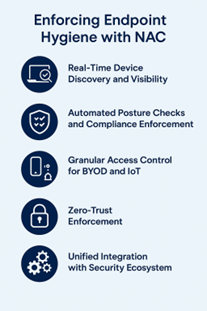
1. Real-Time Device Discovery and Visibility
Unknown devices connecting to the network pose security risks. So, the first step in endpoint security is discovering devices attempting to connect to the network, identifying them, and assessing the risks they pose. Endpoint security with NAC enables continuous device discovery. It ensures that every device connecting to the network, whether a laptop, smartphone, printer, or IoT sensor, across wired, wireless, and VPN channels, is identified. NAC validates the device’s identity, category, and risk profile.
By detecting unmanaged devices instantly and profiling every device, NAC creates visibility across the entire network. IoT endpoint security NAC enforces network access segmentation rules for sensors and controllers.
2. Automated Posture Checks and Compliance Enforcement
Every device is different, and the protection and the risk it carries vary vastly. For instance, an older device that lacks encryption and has not received operating system security updates carries more risks. Endpoint security NAC integration verifies various security parameters of endpoint devices and validates posture for supported devices in real time. NAC solutions check for:
- OS patch levels
- Disk encryption
- Antivirus/EDR status
- Firewall configuration
- USB policies
- Security agent presence
NAC posture check endpoint compliance is a core component of most modern Network Access Control solutions. It can deny access to devices that do not meet compliance requirements, quarantine or move them to a restricted VLAN when integrated with a properly configured network infrastructure. By enforcing compliance, NAC mandates that the devices meet the organizational standards before accessing critical data.
3. Granular Access Control for BYOD and IoT
It is easier to enforce security guidelines for corporate devices managed by the enterprise system administrators. The same cannot be said for personal BYOD devices connecting to the network, especially when employees use them for remote work. These devices demand stricter enforcement.
BYOD endpoint security NAC policy ensures that every employee’s device follows the security guidelines before joining the network. It also isolates guest devices automatically.
IoT devices bring a different set of challenges. They may be remote, unmanned, and least monitored devices that need to automatically connect securely to the network to access services essential to their operation.
These IoT devices are increasing in numbers exponentially, so the network needs to allow secure access to a large number of these devices. Managing them and checking their posture manually can be extremely challenging.
At the same time, they can be business-critical for manufacturing, retail, healthcare, and logistics, and must connect to the network without any issues. So, they need to be secured.
IoT NAC ensures that these smart devices and sensors are restricted from accessing services beyond those required for their operation, thereby significantly reducing the risk of lateral movement.
4. Zero-Trust Enforcement
A well-designed NAC implementation supports zero-trust NAC for endpoint devices. A zero-trust policy ensures that no device is trusted by default; it forces continuous verification and authentication before granting access.
NAC contributes to zero trust by enforcing access based on device posture and identity at connection time, and during periodic rechecks. This prevents compromised endpoints from operating freely within corporate networks and strengthens the organization’s zero-trust architecture.
5. Unified Integration with Security Ecosystem
NAC does not operate as a stand-alone software. Instead, it acts as a policy enforcement layer. API-driven NAC integration enables the NAC platform to connect with SIEM, EDR, MDM, and identity solutions to enhance threat detection and automate control responses. This enhances NAC and endpoint threat prevention, ensuring that risky or suspicious devices are handled immediately.
Benefits of NAC-Enforced Endpoint Hygiene
Implementing a modern NAC solution transforms endpoint security from a reactive approach to an automated, policy-driven process. Key benefits of NAC-enforced endpoint hygiene include:
- Unified visibility across all endpoint devices, from corporate devices to contractor laptops, BYOD phones and tablets, and unmanned IoT devices and sensors.
- Automatic enforcement of security policies without requiring manual IT intervention from the security/IT team.
- Reduced attack surface that minimizes the potential for lateral movement, and prevents ransomware and malware from spreading across the network.
- Improved compliance with continuous posture validation and auditable enforcement of policies.
- A stronger zero-trust framework that ensures that no device is trusted automatically and enables conditional access with continuous validation.
- Scalable protection, ideal for cloud-first, hybrid, and multi-device environments.
Final Thoughts
Today’s device-heavy environments host large numbers of diverse connected devices, and maintaining strong endpoint hygiene with Network Access Control (NAC) has become crucial for enterprises.
NAC security is a strategic layer in most enterprise cybersecurity programs. It enables automated posture checks, granular access control, and real-time enforcement, and ensures that endpoint hygiene is sustainable.
A well-implemented NAC framework strengthens the entire security posture. It makes zero-trust actionable and ensures consistent protection against endpoint-driven attacks. By implementing endpoint hygiene with NAC and following NAC endpoint security best practices, organizations can significantly reduce risks, improve resilience against threats arising from endpoint vulnerabilities, and gain complete control over every device on the network.
Frequently Asked Questions
1. What is NAC in endpoint security?
Network Access Control (NAC) is a security framework that verifies device identity and posture before granting network access, ensuring only compliant, trusted, and secure endpoints connect to enterprise resources.
2. What are two main capabilities of a NAC system?
A NAC system primarily delivers real-time device authentication and continuous posture assessment, allowing organisations to block, quarantine, or restrict non-compliant endpoints and control network access based on security policies.
3. What is NAC compliance?
NAC compliance refers to enforcing organisational security policies by checking whether devices meet required configurations—such as patches, antivirus, encryption, and firewall—before allowing or maintaining access to the network.
4. What are the 4 levels of security clearance?
The four commonly recognised security clearance levels are Confidential, Secret, Top Secret, and Sensitive Compartmented Information, each specifying how restricted access is and what classified information individuals are authorised to handle.
Here’s How You Can Engage with Us:
- Stay Connected: Follow our latest updates, insights, and events on LinkedIn.
- Collaborate with Us: Partner with us to enhance your IT infrastructure or cybersecurity systems.
Let’s work together to drive success and secure your enterprise.
Contact Us | Explore Our Services