Hybrid work environments and applications running on public and private clouds have reshaped the enterprise networks. Data flows continuously between users, devices, and services; this is a major departure from the traditional enterprise network, which was confined to a single location. The modern enterprise network has enabled greater flexibility and significantly enhanced productivity. However, the exponential growth of organizations’ cloud resources, services, and instances, along with a more widespread enterprise network, has also increased exposure to cyber threats. These changes call for enhanced security.
Traditional security tools were designed for a static, on-premises environment. They secured the local digital infrastructure within the organization’s premises using fixed perimeter defenses, such as firewalls and VPNs at the network edge. They worked by comparing network anomalies against a database of known attack signatures, including patterns and identifiers for previously identified malware.
However, modern, stealthy, fileless attacks blend into normal network traffic, hide for weeks, and quietly move through the network to exfiltrate sensitive data. They cannot be identified by traditional defenses.
This is where Network Detection and Response (NDR) becomes indispensable. NDR enables continuous, real-time monitoring of network traffic. It constantly looks for any suspicious behavior and enables rapid response.
This article explains how Network Detection and Response (NDR) uses behavioral analytics and AI-driven monitoring to identify and stop suspicious network activity. It shows how NDR detects hidden threats that traditional security tools miss and enables faster, real-time response. The article also highlights NDR’s place in modern cybersecurity stacks and the business value it delivers.
What Is Network Detection and Response (NDR)?
Network Detection and Response (NDR) is a modern cybersecurity approach that continuously analyzes network traffic to uncover hidden threats and suspicious activity. It helps security teams detect unusual/ abnormal behavior in the network, and:
- Identify threats, contextualize, and prioritize them.
- Investigate potential threats.
- Respond quickly to minimize risk and impact.
How NDR Detects Suspicious Network Activities
Unlike many security tools, NDR can monitor all network traffic, including internal traffic between systems, without any effort, thereby providing complete visibility. As a result, it can detect hidden threats and uncover sophisticated attack techniques, even late-stage movements.
NDR threat detection works by analyzing patterns rather than individual events. Its capabilities include:
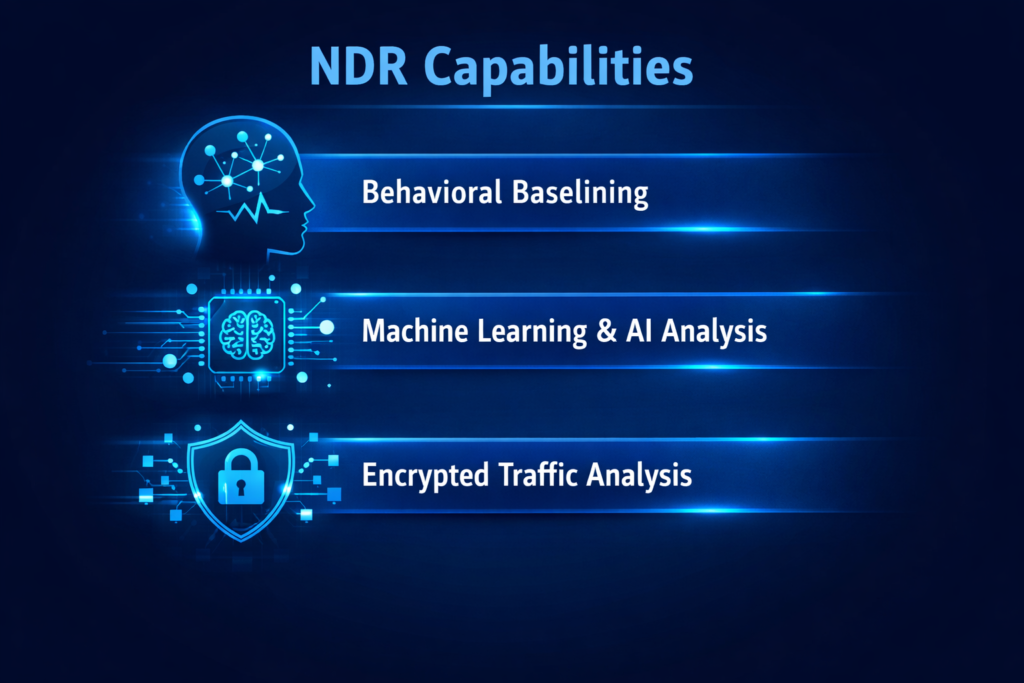
- Behavioral Baselining
NDR learns what normal activity looks like for users, devices, and applications. It identifies deviations and flags them as anomalies. - Machine Learning and AI Analysis
The latest NDR solutions leverage AI models to analyze large volumes of traffic data, learn continuously, and refine detection accuracy. - Encrypted Traffic Analysis
NDR can detect suspicious behavior even when traffic is encrypted by analyzing metadata such as timing, size, and destination.
For example, if a compromised server begins scanning other internal systems for open ports, NDR detects this behavior and identifies it as a classic sign of lateral movement, though no malicious file is present.
How is NDR Different From Traditional Security Tools?
NDR fundamentally differs from traditional network security tools, such as firewalls and antivirus software, in how it operates.
Traditional network tools work by comparing threats against known attack signatures – a database of known attack patterns and identifiers of malware. They follow predefined rules to compare threats against these signatures. When they detect something that resembles/follows the pattern of a known threat, they alert you without providing any context. So, you cannot distinguish between a real threat and a false alert.
In contrast, NDR cybersecurity solutions build a baseline of what “normal” network behavior looks like. AI network security techniques and behavioural analytics in NDR enable them to analyze traffic patterns, device behavior, and communication frequency to uncover hidden risks. When NDR detects any deviations from the established baseline behavior, it flags them as potentially malicious. As a result, a threat pattern that does not match any attack signature can also be detected and addressed. It makes NDR effective against zero-day attacks and insider threats.
For instance, NDR can identify a user’s endpoint device, such as a laptop, suddenly communicating with an unfamiliar external server at odd hours. Even if no malware signature is detected, NDR can detect this anomaly, isolate the device from the network using enforcement tools such as EDR, firewalls, and NAC, and alert you.
NDR vs. XDR
You may often come across comparisons between similar-sounding solutions, such as NDR vs. XDR. While XDR creates broad visibility across endpoints, identities, and networks, it does not provide in-depth or packet-level visibility into network traffic. In contrast, NDR enables you to gain deep, specialised insight into network traffic. This capability enables NDR to fill critical visibility gaps at the network layer and reinforce the visibility provided by XDR.
For instance, NDR can automatically block a connection that exfiltrates data from a database server to an unknown external destination. While doing so, it can also alert your security team in real time. This rapid response significantly reduces attacker dwell time.
Responding to Network Threats with NDR
Detecting a threat in itself is not enough to safeguard your network. You must act fast to limit the damage and contain/neutralize the threat. It is not possible without understanding the nature of the threat. For instance, if you get 10 alerts at the same time and only one of them is a real threat, you need to know the context of the threat and its business impact; only then you will be able to prioritize it over the other alerts and address it first.
When a threat is detected, Network Detection and Response provides context-rich alerts with the vital details, including what happened, which systems are involved, and why the activity is considered risky. It enables you to respond immediately to the threat. It can also respond automatically while alerting you.
NDR may respond to the threat by:
- Preventing the spread by isolating compromised devices
- Blocking malicious traffic using integrated firewalls or network controls
- Enabling faster remediation by triggering automated workflows through SOAR platforms
NDR Tools and Solutions in the Security Stack
Modern NDR tools are not a replacement for existing security tools; rather, they work alongside endpoint, identity, and cloud security tools, complementing them with deep network visibility.
NDR solutions enable:
- Continuous network threat monitoring across on-prem, cloud, and hybrid environments
- AI-driven analytics for detecting unknown and emerging threats
- Forensic investigation tools to support incident analysis and reporting
Use Cases and Business Value of NDR
While NDR primarily monitors the enterprise network and enables threat detection and response, it provides much more value to enterprises by improving overall security effectiveness and operational efficiency, reducing breach impact, accelerating investigations, and demonstrating stronger security governance.
It also supports compliance by providing detailed network activity records during audits or incident reviews. NDR is a prominent feature of the modern Security Operations Center (SOC), which is purpose-built to address the gaps left by traditional network security tools.
NDR can be effective in:
- Detecting zero-day attacks: Threats unknown to the vendor are hard for traditional tools to detect because they are not listed in known attack signatures.
NDR identifies zero-day attacks arising from these threats by leveraging AI and ML to establish a “normal” baseline for your network and flagging any deviations. It also detects these attacks post-compromise by tracking late-stage movements by the attacker that generate network signals. It focuses on the attacker’s intent rather than just malicious code and prevents/reduces the impact of these Zero-day attacks.
- Securing hybrid and multi-cloud environments: These environments are fragmented and lack consistent visibility. Agent-based endpoint tools are limited because installing and managing agents is tedious. Besides, they cannot be installed on unmanaged devices, IoT devices, etc.
In contrast, NDR is usually agentless, enabling it to monitor unmanaged “shadow IT,” IoT devices, and ephemeral cloud workloads that spin up and down rapidly. NDR also provides a “single source of truth” across diverse environments and uses cloud-native sensors and VPC traffic mirroring to capture “east-west”traffic, where attackers typically move laterally to escalate privileges. By ensuring complete visibility, NDR secures hybrid and multi-cloud environments.
- Reducing alert fatigue: NDR cuts unnecessary alerts and prioritises high-risk behaviour. Traditional security tools follow static rules to generate thousands of alerts, low-risk or false positives, based on isolated events. This pushes security teams to chase trivial non-issues, and real threats often slip through.
Behavioral analytics in NDR, in contrast, identifies threats by detecting patterns of risky behavior, such as lateral movement followed by data exfiltration, rather than flagging unusual packets or connections. It leverages AI to correlate network activity over time. It assigns scores to threats and puts them in context, enabling you to prioritize risks that demand immediate attention. With fewer, more actionable alerts, NDR lets you focus on incidents that truly matter and respond faster.
Final Thoughts: Making NDR Central to Modern Network Security
Comprehensive visibility across the network and real-time monitoring of the network traffic are crucial for enterprises today, since the latest cyber threats in the era of cloud sprawl are sophisticated and harder to detect. Traditional security tools are simply inadequate for securing modern enterprise networks against these sophisticated cyber threats.
Network Detection and Response is the perfect tool for securing enterprise networks, combining AI network security, behavioral analytics, and real-time response. It detects subtle anomalies in real time, alerts your security team, and enables rapid threat containment. No wonder security experts ensure integration of NDR in modern cybersecurity architectures.
Integrating NDR to broader security platforms and making it central to enterprise network security lays a powerful foundation for proactive threat detection, faster response, and stronger overall cyber resilience.
FAQs
1. What is Network Detection and Response (NDR)?
Network Detection and Response is a cybersecurity solution for modern enterprise networks. It integrates with broader cybersecurity architectures to continuously monitor network traffic, detect threats using behavioral analytics, and enable rapid investigation and response to suspicious activities.
2. What is the purpose of NDR?
NDR detects hidden, unknown, or advanced threats in network traffic. It reduces attacker dwell time and improves your ability to respond to security incidents quickly.
3. What are the 7 steps in incident response?
The seven steps in incident response are:
- Preparation
- Identification
- Containment
- Eradication
- Recovery
- Communication
- Post-incident review
4. What are NDR rules?
NDR rules define behavioral thresholds, anomaly indicators, and response triggers. They help identify suspicious network activity, prioritize alerts, and guide automated or manual response actions.