Enterprises today must take a multi-pronged approach to ensure cybersecurity, as threats come in various forms. To implement comprehensive cybersecurity in your organization to protect against active attacks, you can install state-of-the-art infrastructure and software systems. However, security breaches do not necessarily result from weaknesses in security systems and tools. Often, manipulation and poor human judgment can weaken cyber defenses from within the organization, allowing attackers to gain control of systems and sensitive data.
Since humans are among the most prominent weak links in cybersecurity, many attackers have shifted their focus from systems to people. They prefer to exploit human traits such as trust, curiosity, fear, and urgency rather than fight cyber defenses and breach firewalls.
Being the preferred mode of business communication, email has been the target of attackers. From a fake invoice sent to a finance executive to a seemingly harmless password reset link, some of the most damaging cyberattacks come via email and often start with a simple click. According to Comcast Business Cybersecurity Threat Report 2022, approximately 67% of all breaches start with someone clicking on a seemingly safe link.
This is why conducting security awareness training and preparing the employees to spot email security threats, such as phishing, social engineering, and business email compromise (BEC), becomes indispensable. It could be the organization’s strongest line of defense. Empowering employees to recognize and respond to email threats eliminates potential vulnerabilities and turns users into powerful defenders.
This article explains what security awareness training is and outlines its importance. It explores how email security awareness, combined with a human-centric security culture, can protect your business from the most common cyber threats.

Why Are Humans the Weakest Link In Cyber Defense?
Human employees are among the weakest links in an otherwise robust cyber defense strategy. The psychology behind social engineering via email attacks, including phishing, business email compromise (BEC) scams, and malicious attachments, is well understood.
These emails usually appear to come from a known contact but are actually from an impersonator sending malicious links and attachments. Employees trust the mail to be from someone they know and respond quickly without verifying whether it originated from that person. Through these emails, cyber attackers exploit emotional triggers, including:
- Urgency – “If you don’t act now, you will lose access to your files forever.”
- Fear – “If you fail to do this, your account will be suspended and cannot be recovered.”
- Authority – “This is from the CEO’s desk. Send this financial report asap.”
Employees follow the instructions in the email without verifying the sender’s identity and send sensitive data or complete transactions. This practice of manipulating employees using emotional triggers is called social engineering. Attacks that use social engineering do not need to fight your cyber defense system actively. Instead, they can choose to target human trust.
Email security threats work because humans are the easiest point of entry. A well-crafted, seemingly legitimate message can slip through the defenses of sophisticated cybersecurity systems with relative ease. That is why training the people to pause, verify, and think before clicking is crucial for ensuring email security. This is where security awareness training comes in.
What Is Security Awareness Training?
Security awareness training is a structured program that educates employees about cyber threats and equips them to spot and prevent them. It differs from conventional training programs in a few ways.
Firstly, it is not a program conducted once a month or a year and then forgotten; it’s a continuous learning process. Secondly, it includes a wide range of training methods to cover the extensive range of threats you need to address; in addition to regular training, workshops, and follow-up sessions, it includes interactive simulations, short video lessons, and real-world phishing awareness tests.
Security awareness training aims to help employees develop instinctive vigilance and follow best practices instinctively without requiring any oversight. It strives to transform employees from being passive users into proactive defenders.
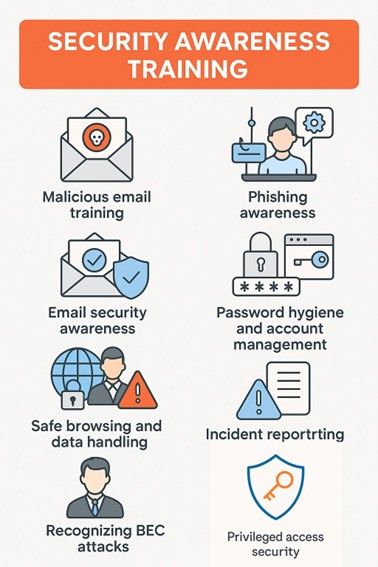
Security awareness training covers:
- Email security awareness and malicious email training
- Phishing awareness and simulations
- Various types of cyberattacks and email security threats
- Password hygiene and account management
- Safe browsing and data handling
- Recognizing Business Email Compromise (BEC) attacks
- Social engineering training
- Privileged access security
- Incident reporting and escalation
The Importance of Email Security Awareness
Email security awareness is the most critical subset of security awareness training because it involves a greater human element and employee manipulation than any other form of cyber threat. Email security training should be the primary focus of security awareness training programs.
Email security awareness aims at teaching employees to:
- Examine and verify sender addresses carefully.
- Hover and pause over links before clicking.
- Verify the senders and their requests via secondary channels, such as phone calls.
- Report suspicious messages to IT and cybersecurity teams promptly.
- Observe vigilance, follow best practices in email security, and make the corporate inbox safer.
Organizations that conduct regular malicious email training programs and attack simulations achieve tangible success in reducing successful attacks.
Building a Human-Centric Security Culture
Training individuals and building email security awareness in itself is not adequate to secure an organization against threats. It is indispensable to ensure understanding and alignment across the organization.
You need to create a uniform mindset across the organization so employees comply with the cybersecurity policies that safeguard the organization against email threats. You can achieve that only by building a human-centric security culture within the organization. When employees feel responsible for protecting their organization, security becomes second nature.
The best way to build this human-centric security culture is by adopting a top-down approach. You must start with the business leaders, management, and top executives. When they participate in email security awareness training, it sends a strong message. When the leaders follow protocols, take cybersecurity seriously, and identify and report threats promptly, it encourages adoption across the organization. Email security becomes everyone’s responsibility as a result. Employees will constantly look for email threats. Over time, they will recognize manipulation attempts instinctively.
A culture of awareness transforms users into what many experts call the “human firewall”.
Best Practices for Effective Security Awareness Training
Best practices for the effective implementation of security awareness training include:
- Delivering regular, short sessions rather than lengthy ones at long intervals: This promotes micro-learning and keeps user attention high. It also keeps employees up to date on the latest threats and countermeasures.
- Simulating phishing attacks: Simulating real-world attack scenarios helps reinforce learning and improve preparedness to respond to these threats.
- Tailoring content to roles: Every team faces different risks. For instance, finance teams are at risk of leaking/losing sensitive financial data if an attacker successfully conducts a social engineering attack. Other teams, such as HR or IT teams, do not face the same risks. So, it is crucial to customize the training program and content to the roles and associated risks, so that staff can avoid email threats specifically targeting them.
- Reinforcing through policy reminders: When you align your company policy with the security practices you preach, you seamlessly integrate the lessons into daily operations.
- Using gamification and recognition: Gamifying threat recognition and reporting encourages employees to actively look for cybersecurity threats, follow the protocols, and report threats immediately. It rewards participation and good security behavior.
- Measuring and improving: Training employees is one thing, but tracking how they apply their knowledge in the real world is what keeps your organization secure in the long run. It is crucial to track their progress through click rates and reports, and to provide ongoing feedback to continuously improve their attitude and behavior in threat identification and response.
By combining email security training with engagement-driven learning, you can achieve sustainable behavioral change and maintain consistent employee email security best practices.
Final Thoughts
Cybersecurity today is not just about creating a robust cyber defense with cutting-edge security tools; it is about combining the latest and greatest technology with uniformly aware employees who can spot all kinds of cyber threats and respond to them in accordance with security protocols. So, email security is as much about people as it is about technology.
Security awareness training equips employees to identify and resist email security threats, such as phishing and business email compromise (BEC), and to prevent manipulative tactics right from the beginning. By creating email security awareness and inculcating human-centric security practices, you can protect your employees from psychological manipulation and your organization against social engineering, BEC, and malicious emails.
Depending on how aware or aligned your workforce is towards email security practices, they can either be your weakest link or your first line of defense. So, by training them well, you can drastically improve your organization’s resilience and security posture, safeguarding it against the evolving tactics of cyber attackers.
FAQs
1. What is security awareness training?
Security awareness training aims to educate employees to promptly identify cyber threats, such as phishing, BEC, and social engineering, and avoid them. It fosters awareness, vigilance, and accountability, thereby strengthening your organization’s overall cybersecurity posture.
2. What are the 5 C’s of security training?
The 5 C’s of security awareness training are Culture, Communication, Consistency, Collaboration, and Continuous improvement.
3. What are the four types of security training?
The four types of security awareness training that cover a whole range of human and technical cybersecurity readiness include general awareness, role-based training, technical security instruction, and compliance-driven programs.
4. How to create a security awareness training?
You can create a human-centric security awareness training program by starting with risk assessment, defining goals, choosing interactive learning formats, integrating phishing simulations, and reinforcing lessons regularly.
Here’s How You Can Engage with Us:
- Stay Connected: Follow our latest updates, insights, and events on LinkedIn.
- Collaborate with Us: Partner with us to enhance your IT infrastructure or cybersecurity systems.
Let’s work together to drive success and secure your enterprise.
Contact Us | Explore Our Services